
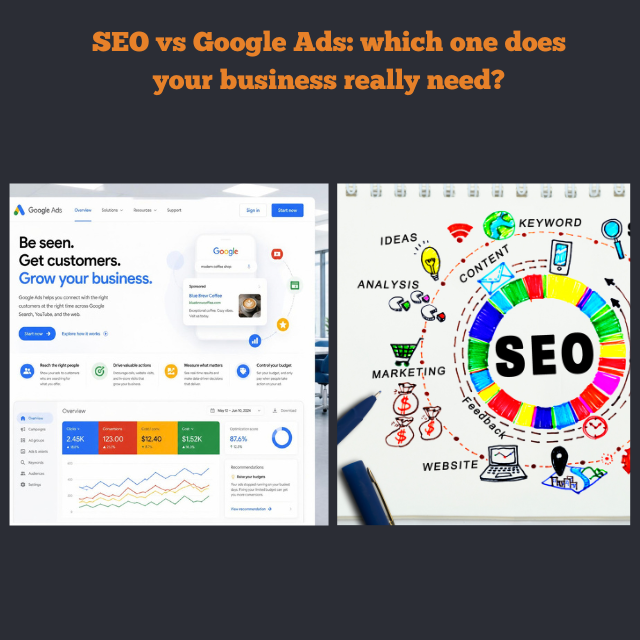
You want more customers online. You have a limited marketing budget. So where should you invest—SEO or Google Ads?
This is one of the most common questions small business owners and entrepreneurs ask.
And honestly, there isn’t one answer that works for every business.
SEO and Google Ads solve different marketing problems.
SEO helps your business build organic visibility in search results over time. Google Ads can put your business in front of relevant people through paid search placements when you are ready to invest in traffic and conversions.
The right choice depends on your business goals, budget, competition, customer journey, and how quickly you need results.
At Digital Rise, we believe digital marketing should not be about choosing a trendy channel just because everyone else is using it. It should be about choosing the strategy that makes sense for your business.
Let’s break it down.
What is SEO?
SEO, or Search Engine Optimization, is the process of improving your website and online content so that search engines can better understand and surface your pages for relevant searches.
Imagine you run a digital marketing business.
A potential customer searches:
“digital marketing freelancer for small business”
If your website has useful, relevant content and strong search visibility, SEO can help you compete for that organic search traffic.
SEO can include:
- Keyword research
- Helpful website content
- On-page optimization
- Technical SEO
- Internal linking
- Local SEO
- Website performance
- Relevant backlinks
- Content that answers customer questions
But SEO isn’t simply about putting keywords on a page.
Modern search is increasingly focused on understanding what the user actually wants.
Google’s Search documentation continues to evolve alongside changes in search features and AI-related search experiences, so businesses should focus on creating useful, people-first content rather than relying on outdated SEO tricks.
What Are Google Ads?
Google Ads is a paid advertising platform that allows businesses to promote their products or services across Google’s advertising ecosystem.
For example, someone searches:
“best digital marketing agency for small business”
A relevant business may use Google Search Ads to appear in sponsored results for that query.
Unlike SEO, Google Ads involves paying for advertising rather than waiting to build organic visibility.
Google has also been adding AI-powered capabilities to Search campaigns. Its current AI Max for Search campaigns includes features such as expanded search-term matching, AI-assisted text customization, and Final URL expansion.
That means today’s Google Ads landscape is becoming increasingly automated—but strategy, targeting, conversion tracking, landing-page quality, and budget control still matter.
SEO vs Google Ads: The Key Difference
Here’s a simple way to think about it:
| SEO | Google Ads |
|---|---|
| Focuses on organic visibility | Focuses on paid visibility |
| Usually takes time to build | Can generate traffic after campaigns become eligible to serve |
| Builds long-term search presence | Useful for immediate campaign objectives |
| No direct cost per organic click | Advertising spend is required |
| Requires ongoing content and optimization | Requires ongoing campaign management |
| Can support brand authority | Can target specific commercial searches |
| Results can compound over time | Results depend on ongoing ad investment |
Neither approach is automatically right for every business.
The question is:
What does your business need right now?
When Should Your Business Focus on SEO?
SEO can make sense when you want to build a stronger long-term online presence.
1. You Want Sustainable Organic Traffic
If people regularly search for your products or services, building organic visibility can become an important source of website traffic.
For example:
“digital marketing services for startups”
“SEO services for small business”
“social media marketing freelancer”
Creating genuinely useful pages around relevant customer needs can help your website compete for those searches.
2. You Want to Build Trust
People often research a business before contacting or buying from it.
A website filled with helpful guides, case studies, FAQs, service pages, and useful resources can demonstrate expertise.
Instead of simply telling customers:
“We are experts.”
your content can show them that you understand their problems.
3. You Can Wait for Long-Term Growth
SEO generally requires patience.
You need to create useful content, improve your website, earn relevant authority, monitor performance, and adapt as search behavior changes.
It is better viewed as a long-term marketing investment rather than a quick traffic switch.
When Should Your Business Consider Google Ads?
Google Ads can be useful when you need to reach potential customers through paid search and have a clear conversion goal.
1. You Need Traffic for a Specific Offer
Suppose you launch:
- A new service
- A limited-time offer
- A consultation
- A new product
- A seasonal promotion
Paid search can help you actively promote that offer to relevant audiences.
2. You Want to Test Demand
Let’s say you have created a new service but aren’t sure which message customers respond to.
A controlled advertising campaign can provide data about:
- Search terms
- Ad messaging
- Click-through behavior
- Landing pages
- Leads
- Conversions
That information can help you understand your market.
3. Your Customers Have Strong Purchase Intent
Search queries can reveal what someone wants at that moment.
Compare:
“What is SEO?”
with:
“SEO agency pricing”
The second search suggests a different stage of the buying journey.
Google Ads can be useful for reaching people searching around relevant commercial intent.
SEO or Google Ads: What If You Have a Small Budget?
This is where many businesses get stuck.
They think:
“I can only afford one.”
Instead of automatically choosing one channel, first identify your objective.
If your priority is long-term visibility:
Consider investing more effort into:
SEO + helpful content + local search + website optimization
If your priority is generating enquiries for a specific service:
Consider:
Google Ads + conversion-focused landing page + strong offer + tracking
If you need both:
A combination can make sense.
For example:
SEO builds your long-term organic presence.
Google Ads helps you capture relevant paid demand while that organic presence develops.
Can SEO and Google Ads Work Together?
Yes.
In fact, they can complement each other.
Imagine someone searches for your service.
Your Google Ad may appear as a paid result while your website may also appear organically.
Even when you don’t rely on the two channels in exactly the same way, the data from paid campaigns can provide useful insights into customer search behavior and messaging.
For example, your advertising campaign may reveal that customers frequently respond to a particular service phrase.
That insight can influence your website copy or future content strategy.
At the same time, your SEO content can help answer informational questions that people have before they become ready to contact you.
Paid and organic search don’t have to be enemies. They can be two parts of the same customer journey.
What About AI and the Future of Search?
This is an important consideration for businesses in 2026.
Search is changing.
Google is increasingly using AI across its advertising and search experiences. In Google Ads, AI Max for Search campaigns can use AI for search-term matching, ad asset customization, and landing-page selection.
For businesses, this means one thing:
Don’t build your entire marketing strategy around one keyword or one old SEO trick.
Instead, build a strong digital presence around:
- Real customer questions
- Helpful content
- Clear service information
- Strong website experience
- Relevant keywords and topics
- Good conversion paths
- Accurate business information
- Measurable marketing goals
Technology may change.
Customer needs remain at the center.
5 Questions to Ask Before Choosing SEO or Google Ads
Before spending your marketing budget, ask yourself:
1. What is my main goal?
Do you want:
Brand awareness? Leads? Sales? Website traffic? Local visibility?
Your goal should influence your channel.
2. How quickly do I need results?
If you need to promote a time-sensitive offer, paid advertising may be relevant.
If you’re building a long-term search presence, SEO may be more appropriate.
3. What is my competition doing?
Search your important keywords.
Look at:
- Paid ads
- Organic results
- Competitor websites
- Content quality
- Offers
- Landing pages
Understanding the search landscape can help you make a more informed decision.
4. Can my website convert visitors?
This is often forgotten.
Getting traffic is only one part of marketing.
If your website is confusing, slow, difficult to navigate, or doesn’t clearly explain your offer, increasing traffic may not solve the underlying problem.
5. Can I measure the outcome?
Don’t measure success only through:
Clicks + impressions + likes.
Look at business outcomes such as:
- Leads
- Calls
- Enquiries
- Bookings
- Purchases
- Cost per lead
- Conversion rate
- Revenue
A Simple Example for a Small Busines
Let’s say you own a local salon.
You want more customers.
SEO Strategy
You could work on:
“best salon in [your city]”
“hair salon near me”
“bridal makeup services”
You could improve your local presence, create useful service pages, publish helpful content, and collect genuine customer reviews.
Google Ads Strategy
You could create a campaign around relevant services such as:
“bridal makeup near me”
or
“hair salon appointment”
and send potential customers to a focused landing page.
Combined Strategy
You could use paid advertising to generate enquiries while continuously improving your organic presence.
This creates a more complete search strategy.
Common Mistakes Businesses Make
Mistake 1: Expecting SEO Results Overnight
SEO is not a magic button.
It requires consistent work and patience.
Mistake 2: Running Ads Without Tracking Conversions
Getting clicks doesn’t automatically mean getting customers.
You need to understand what happens after the click.
Mistake 3: Sending Every Ad to the Homepage
A dedicated landing page may be more appropriate when someone is searching for a specific service or offer.
Mistake 4: Choosing Keywords Without Understanding Search Intent
A keyword can have thousands of searches but still bring little business value if it doesn’t match what you offer.
Mistake 5: Copying Competitors
Your business has its own customers, strengths, experience, and story.
Your digital marketing should reflect that.
So, Which One Does Your Business Really Need?
The answer depends on your situation.
SEO may fit businesses looking to build long-term organic visibility.
Google Ads may fit businesses looking for targeted paid traffic around specific commercial goals.
A combination can make sense when you want to build long-term visibility while also using paid campaigns to support immediate or measurable objectives.
There is no universal formula.
Your business goals, audience, competition, budget, website, and customer journey should guide the decision.
Final Thoughts
SEO vs Google Ads isn’t really about choosing a winner.
It’s about understanding what role each channel can play in your digital marketing strategy.
If you are a small business owner, startup, freelancer, or entrepreneur, don’t ask:
“Which marketing channel is the best?”
Ask:
“Which marketing channel makes the most sense for my business right now?”
That small change in thinking can lead to a much smarter marketing strategy.
At Digital Rise, we help businesses build practical digital marketing strategies around their goals—not just chase clicks and impressions.
From SEO and content marketing to Google Ads, social media marketing, lead generation, and direct messaging, our focus is on creating a digital presence that connects your business with the right audience.
Ready to Grow Your Business Online?
Digital Rise — Your Growth. Our Strategy.
Let’s turn your online visibility into meaningful customer opportunities.